5 Mins Read
Generative vs. Agentic AI: The Strategic Imperative for IT Services in 2025
Introduction: From Co-Pilot to Auto-Pilot
By now, every C-suite leader in IT services has heard of , and likely experimented with Generative AI (GenAI). It has become the co-pilot for developers, analysts, and marketers alike, enabling faster code generation, streamlined content creation, and accelerated data analysis.
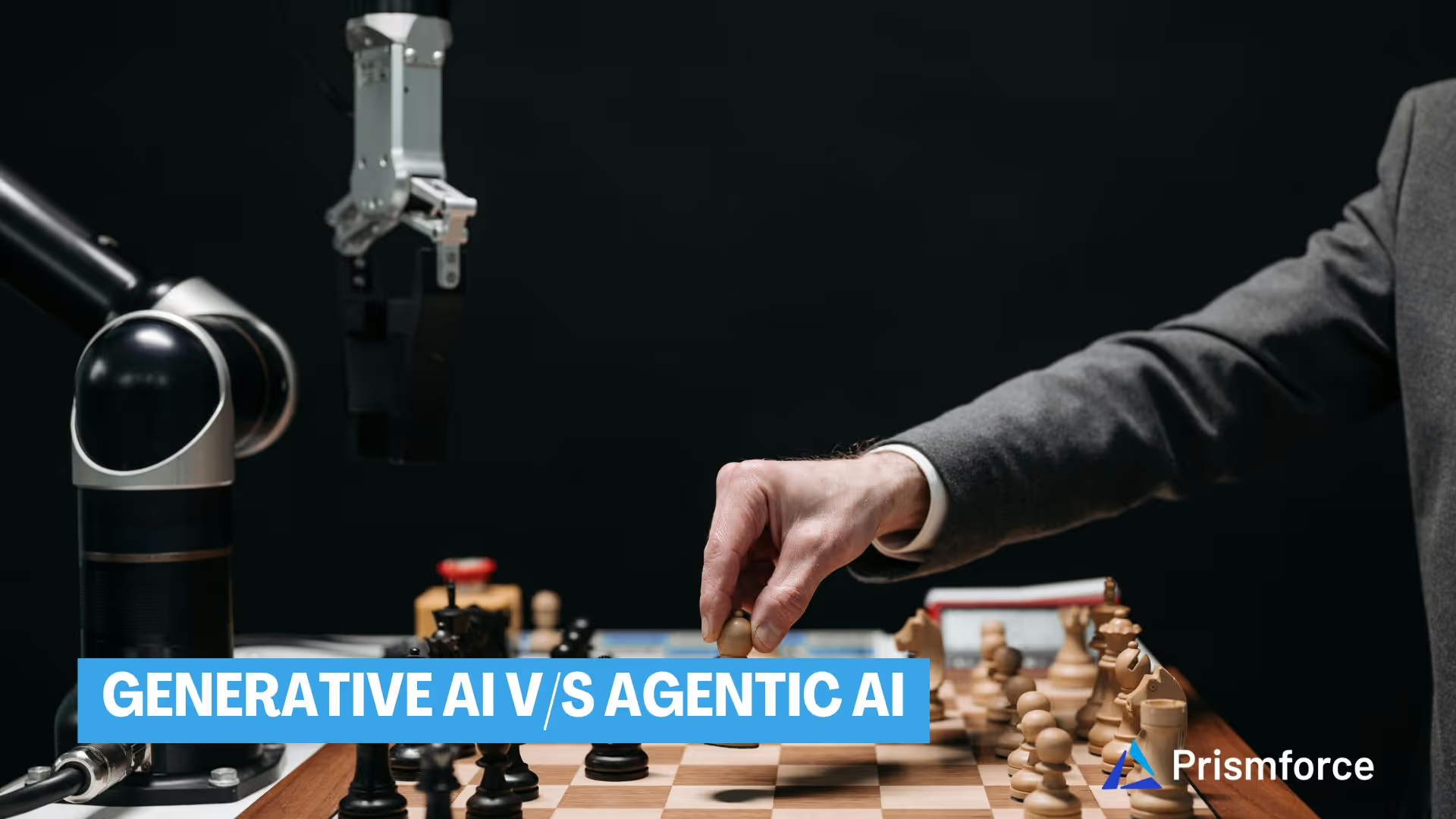
But in 2025, the conversation is shifting to what comes next: Agentic AI. Where GenAI assists, Agentic AI acts. Where GenAI reacts, Agentic AI anticipates. This evolution is more than incremental , it represents a strategic inflection point for IT services firms.
Think of it this way: Generative AI is the co-pilot in the cockpit; Agentic AI is the auto-pilot that charts the course, navigates turbulence, and lands the plane. For IT services leaders, the transition from generative to agentic is not optional. It is the difference between leveraging AI as a tool and embedding AI as a core driver of new business models, client value, and competitive advantage.
Generative AI: The Foundation
Generative AI can be best understood as a creative assistant , one that takes an input prompt and produces original outputs in text, code, or images.
Current Applications in IT Services
- Code Generation: Helping developers write boilerplate code, suggest fixes, and accelerate sprints.
- Content Creation: Drafting documentation, marketing collateral, or knowledge base articles.
- Data Analysis: Summarizing datasets or producing insights for reporting.
The Limitation
While powerful, GenAI is inherently reactive. It responds to prompts but does not independently decide what goals to pursue, what actions to take, or how to adapt if conditions change. For IT services firms aiming to deliver end-to-end solutions, this reactive nature caps the potential impact.
Agentic AI: The Proactive Revolution
Agentic AI represents a new paradigm. Unlike Generative AI, which produces outputs, Agentic AI systems:
- Are goal-oriented: They don’t just respond to instructions; they pursue defined objectives.
- Plan and execute: They design multi-step workflows and carry them out autonomously.
- Adapt dynamically: They learn from feedback, monitor progress, and adjust in real time.
In short, Agentic AI is not just about creating content or code; it’s about making decisions and taking action on behalf of users or organizations.
A Strategic Imperative for IT Services
Why does this distinction matter for the C-suite in IT services? Because Agentic AI has the potential to reshape delivery models, unlock new revenue streams, and create competitive differentiation.
Here are three transformative applications:
1. Automated Project Management
- Traditional model: Teams of project managers scope requirements, allocate resources, track deliverables, and resolve bottlenecks.
- Agentic AI model: An AI agent can scope a project, align resources, monitor progress, and even auto-correct code or deployment errors.
- Business impact: Reduced overhead, faster time-to-value, and increased client satisfaction.
2. Proactive Cybersecurity
- Traditional model: Security operations centers (SOCs) rely on analysts and dashboards to detect anomalies.
- Agentic AI model: AI agents continuously monitor networks, identify anomalies, simulate potential exploits, and autonomously neutralize threats — sometimes before a human even notices.
- Business impact: Stronger client trust, compliance assurance, and premium service offerings.
3. Self-Optimizing Operations
- Traditional model: Teams manually scale cloud infrastructure, balance workloads, and optimize costs.
- Agentic AI model: Autonomous agents manage cloud resources in real time, dynamically scaling workloads to optimize cost and performance.
- Business impact: Reduced operational costs for clients, higher margins for service providers.
For IT services firms, adopting Agentic AI is not just about operational efficiency. It’s about positioning as the partner who can deliver autonomous AI solutions, not just advisory or staffing.
The Interplay: Where GenAI and Agentic AI Converge
It’s tempting to view this as a “Generative vs. Agentic” showdown, but the reality is more nuanced. The two paradigms complement each other.
- An Agentic AI system managing a large digital transformation project could use Generative AI to draft client-facing reports, compose personalized emails, or summarize sprint updates.
- Conversely, Generative AI’s creative capabilities provide the raw material that Agentic AI systems can deploy in achieving broader goals.
In practice, IT services firms will see blended solutions emerge — with generative and agentic components working together to deliver proactive, intelligent, and client-centric outcomes.
Challenges and Considerations
C-level leaders must balance enthusiasm with responsibility. Deploying Agentic AI at scale introduces new challenges:
Governance and Oversight
Agentic systems must be deployed with clear governance. Human oversight remains essential to ensure accountability and avoid unintended consequences.
Ethical Frameworks
Autonomous decision-making raises questions about bias, fairness, and alignment with human values. IT services firms must adopt robust ethical frameworks and transparent auditing mechanisms.
Workforce Evolution
Agentic AI will not eliminate talent needs , it will reshape them. Project managers may evolve into AI supervisors, while developers may focus more on strategic design and validation rather than repetitive coding. Upskilling programs will be critical.
Conclusion: Act Now, Lead Tomorrow
Generative AI gave IT services firms a creative assistant. Agentic AI provides an autonomous partner. The difference is not incremental ,it is transformative.
In 2025 and beyond, the market will favor firms that can move beyond “using AI” to building, deploying, and scaling autonomous AI solutions. This is not just a matter of efficiency —it is the foundation of new business models, premium client offerings, and market leadership.
The strategic imperative is clear: embrace Agentic AI now, or risk being outpaced by competitors who do.
FAQs on Agentic AI for IT Services
How does Agentic AI differ from traditional AI?
Traditional AI models are often narrow, task-specific, and reactive. Agentic AI is goal-driven and proactive, capable of independently planning and executing multi-step processes rather than waiting for explicit prompts.
How does Agentic AI make decisions?
Agentic AI systems use a combination of planning algorithms, reinforcement learning, and real-time feedback loops. They evaluate progress against defined goals, adapt strategies as needed, and make decisions in pursuit of those objectives.
Is Agentic AI safe and aligned with human values?
Safety and alignment depend on design, governance, and oversight. Proper guardrails, human-in-the-loop mechanisms, and ethical AI frameworks are essential to ensure alignment with organizational and societal values.
What are real-world applications of Agentic AI?
- Automated project management in IT services
- Proactive cybersecurity monitoring and defense
- Cloud resource optimization
- Customer support agents that resolve issues end-to-end without escalation
- Supply chain automation for IT hardware and services logistics
What ethical concerns are associated with Agentic AI?
- Potential bias in autonomous decision-making
- Accountability for AI-driven actions
- Privacy and data security concerns
- Risk of over-automation reducing meaningful human oversight
What are the top use cases of Agentic AI in enterprises?
- IT operations automation
- Cybersecurity defense
- Autonomous cloud optimization
- Customer service automation
- Project and program management
What’s the ROI of adopting Agentic AI for IT operations?
ROI comes from:
- Cost savings through automation of repetitive tasks
- Revenue growth by offering higher-value, autonomous AI solutions to clients
- Risk reduction via proactive cybersecurity
- Client retention through improved service delivery and faster project turnaround
Enterprises piloting Agentic AI in IT operations have reported 20–40% efficiency gains and double-digit improvements in client satisfaction scores.
Get exclusive access to workforce and talent insights
Thank you! Your submission has been received!
Oops! Something went wrong while submitting the form.
Demo Prismforce products
Get in touch with our experts and sign up for a demo

.avif)