5 Mins Read
How to Build a Skill-Based Organization: A Practical Framework for Enterprises
.avif)
Most enterprises believe they understand the skills their workforce has. In reality, they don't.
When organizations lack a clear, real-time view of skills, they overhire externally while critical capabilities sit idle internally. They miss redeployment opportunities when demand shifts. Utilization drops, hiring costs rise, and workforce decisions slow down.
This is why leading enterprises are moving toward a skill-based organization—where skills, not job titles, become the foundation for how work gets done.
What Is a Skill-Based Organization?
A skill-based organization uses verified skills as the system of record for hiring, staffing, learning, and workforce planning. Work is matched to people based on capabilities, not static roles, enabling faster deployment and better utilization.
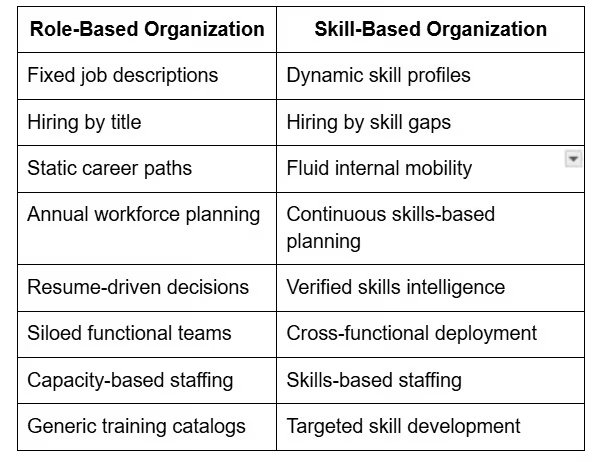
Instead of organizing around fixed job descriptions, skills-based organizations dynamically align work to the people best equipped to do it—regardless of title or reporting line.
In practice, skills are applied across:
- Hiring: Filling skill gaps, not job descriptions
- Staffing: Matching skills to project requirements
- Learning: Building skills based on business demand and adjacencies
- Internal mobility: Redeploying talent based on capabilities
The foundation of this model is verified skills. Self-reported skills don't scale. Skills intelligence requires continuous inference from work history, certifications, learning activity, and project delivery.
Why Role-Based Organizations Are Failing
Role-based organizations were designed for stability. Modern enterprises operate in constant change.
Job roles evolve faster than job descriptions can keep up. A "data analyst" role today looks nothing like it did just a few years ago. The half-life of many technical skills has dropped below three years.
According to McKinsey, companies using skills-based hiring are five times more predictive of job performance than those relying on education and credentials. Yet only 17% of organizations feel confident predicting their future skills needs.
When enterprises plan headcount without understanding skills, they make expensive mistakes:
- Overhiring externally: 87% of organizations report current or imminent skills gaps, even though many required skills already exist internally
- Bench inefficiency: Services firms cannot see deployable skills between projects
- Poor redeployment: When demand shifts, enterprises don't know who can move where
Deloitte research shows that 72% of CEOs rank talent gaps as their top business challenge.
Skill-Based Organization vs Role-Based Organization
The Four Pillars of a Skill-Based Organization
A skill-based organization is not an HR initiative—it is an operating model. Four pillars make it work.
1. Unified Skills Ontology
A standardized definition of skills across the enterprise, mapping how skills relate to roles, projects, and each other.
2. Real-Time Skills Intelligence
Continuous inference of skills from work, learning, and performance data—not annual surveys or static profiles.
3. Skill-Driven Talent Decisions
Using skills to drive hiring, staffing, learning, and workforce planning decisions.
4. Internal Talent Mobility
Redeploying people across teams and projects based on verified capabilities.
Without all four, skills initiatives remain fragmented and fail to scale.
Skills Taxonomy vs Skills Ontology: What's the Difference?
This distinction is critical and often misunderstood.
A skills taxonomy is a hierarchical classification of skills. It answers the question: What category does this skill belong to?
A skills ontology is a dynamic network that defines relationships between skills, roles, projects, and learning content. It answers: If someone has Skill A, what adjacent work can they do?
Taxonomies organize data. Ontologies enable intelligence.
Without an ontology, organizations end up with spreadsheets. With one, they gain the foundation required for automated matching, redeployment, and workforce planning.
What Is Skills Intelligence (And Why Most Systems Fail)
Skills intelligence is the ability to continuously understand, infer, and act on workforce skills in real time.
Most skills systems fail because:
- Skills data is siloed across HRIS, LMS, ATS, and project tools
- Static taxonomies cannot keep up with how skills evolve in real work
- Skills exist only in dashboards, not operational workflows
- Adoption is limited to HR, not business teams
The result is familiar: enterprises invest heavily in skills technology but continue making decisions based on resumes and org charts.
Skills intelligence only works when it is operational, not theoretical.
How to Build a Skill-Based Organization: Step-by-Step Framework
Building a skill-based organization requires operational change, not one-time skill mapping.
Step 1: Audit Skill Blind Spots
Identify where talent decisions are made without knowing what skills exist internally.
Common blind spots include:
- Hiring externally for skills that already exist inside the organization
- Inability to answer "who knows X?" quickly
- Bench talent with no visibility into capabilities
Step 2: Establish a Skills Intelligence Layer
Deploy infrastructure that:
- Maintains a unified skills ontology
- Continuously infers skills from real work
- Normalizes data across HR, learning, and delivery systems
- Provides real-time visibility into supply and demand
Step 3: Integrate Skills Into Daily Workflows
Skills intelligence must live where decisions happen.
- Hiring: Surface internal skills before opening requisitions
- Staffing: Identify deployable and adjacent skills for projects
- Learning: Trigger development aligned to future demand
- Performance: Track skills built, not just outcomes
Step 4: Operationalize at Scale
Use operational dashboards for:
- Skills supply-demand matching
- Skill gap analysis
- Redeployment opportunities
- Utilization optimization
Organizations using skills-based hiring reduce time-to-hire by approximately 25% and improve retention by 15%.
How Skill-Based Organizations Improve Internal Talent Mobility
Skill-based organizations break work into smaller units and move talent dynamically across projects and teams.
This enables:
- Higher utilization of in-demand skills
- Faster redeployment when demand shifts
- Improved retention through lateral growth
- Stronger cross-functional capability
For tech services firms and global capability centers, internal mobility is not optional—it directly impacts margins and value delivery.
Why Agentic AI Is Critical for Skill-Based Organizations at Scale
Most skills systems recommend. Agentic AI acts.
At enterprise scale, manual workforce decisions break down:
- Decision latency reduces utilization
- Human bottlenecks slow redeployment
- Workforce planning becomes computationally impossible
Agentic AI systems automatically:
- Trigger learning for adjacent skills
- Surface internal candidates
- Recommend staffing changes
- Update workforce plans as demand shifts
Skills intelligence becomes an operating system, not a report.
Frequently Asked Questions About Skill-Based Organizations
What are the primary business benefits of a skill-based organization?
They improve placement accuracy, responsiveness to market change, retention, and utilization—transforming workforce cost into a strategic asset.
How long does it take to implement?
Most enterprises see measurable impact within 6–9 months when skills are embedded into workflows rather than treated as an HR-only initiative.
What role does AI play?
AI enables continuous skills inference, intelligent matching, and automation. Agentic AI allows skills systems to act autonomously at scale.
Skills Are the Operating System of Modern Enterprises
Role-based organizations were built for stability. Skill-based organizations are built for change.
The question is no longer whether enterprises need skills intelligence—it's how quickly they can operationalize it.
Skills aren't the future of work. They're the infrastructure of work.
Ready to build a skill-based organization? See how enterprises are using real-time skills intelligence to transform hiring, staffing, and workforce planning with Prismforce.
Get exclusive access to workforce and talent insights
Thank you! Your submission has been received!
Oops! Something went wrong while submitting the form.
Demo Prismforce products
Get in touch with our experts and sign up for a demo
.avif)